
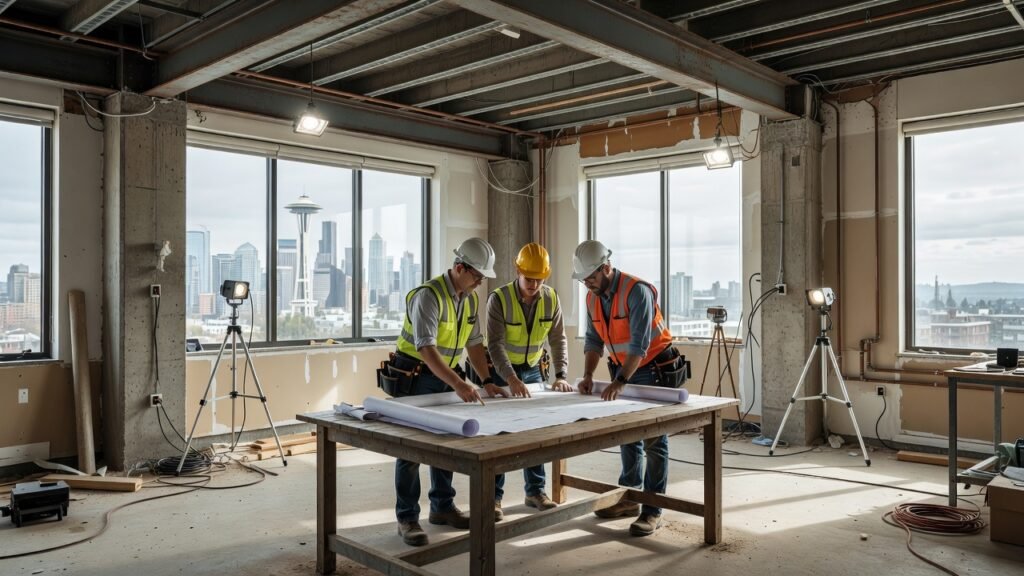
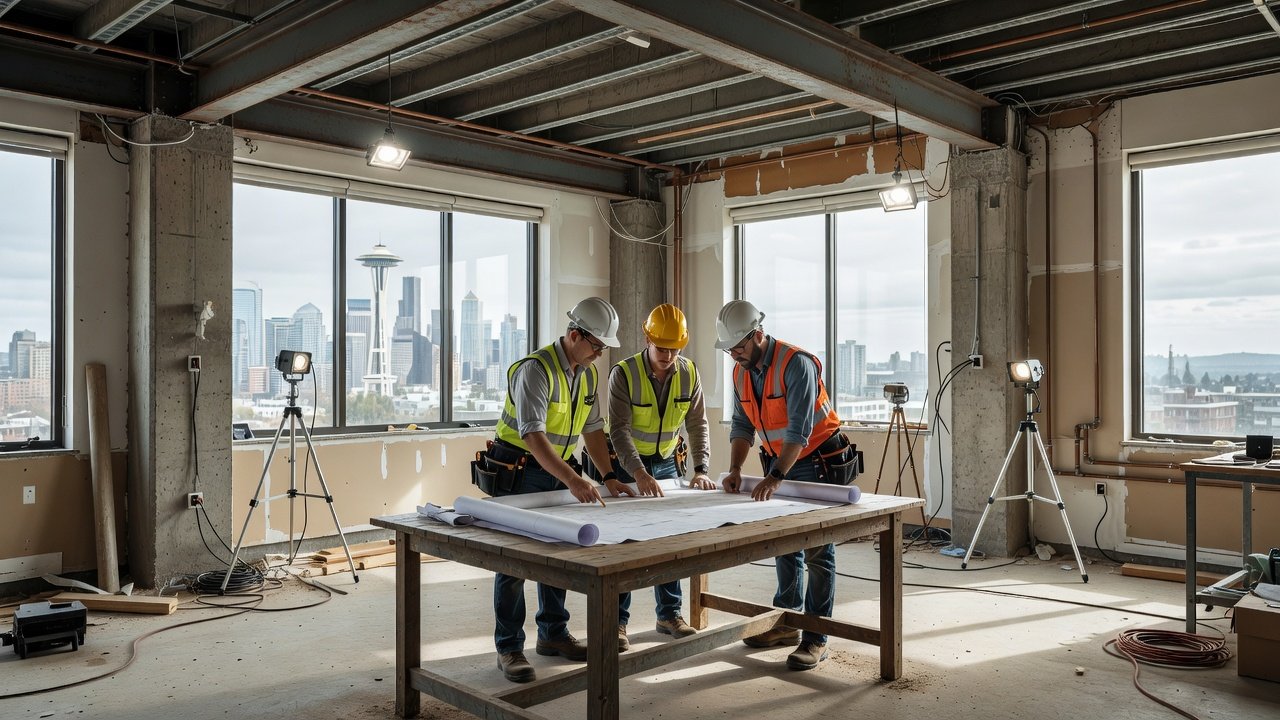
Smart Commercial Renovation Contractors Seattle: 2026 Guide for Seattle, WA Residents
How do you know whether the contractor walking through your commercial space actually knows what they’re doing, or whether they’re just good at giving confident answers? That question comes up more than people admit, and in Seattle’s current construction climate, the stakes are real. We’ve heard versions of it from property owners in Capitol Hill, Sodo, Ballard, and Bellevue’s eastside corridor and the honest answer is that credential-checking and red-flag recognition take some specific knowledge to do well. That’s what this post is about.
As commercial renovation contractors serving Seattle, WA and the surrounding metro, we’ve been called in after enough failed projects to recognize the warning signs early. This isn’t a generic checklist. These are the actual problems we diagnose when a commercial renovation goes sideways, along with what caused them and how they get fixed.
Problem 1: The Contractor Couldn’t Pull Permits or Wouldn’t
Symptoms: Work stalls out mid-project, or you discover after the fact that walls were moved, electrical was rerouted, or a bathroom was added without a permit on file with the City of Seattle Department of Construction and Inspections.
Likely cause: The contractor either wasn’t licensed to pull commercial permits in Washington State, or they were deliberately avoiding the permit process to cut timeline and cost on their end. In Seattle, commercial tenant improvements in spaces over a certain square footage threshold require a full building permit, fire code review, and in many cases, a mechanical and electrical sub-permit. Skipping that isn’t a gray area.
The fix: A licensed general contractor goes back through the work, gets a retroactive permit where Seattle SDCI allows it, and brings everything up to current 2026 code. Depending on what was done, that can mean opening walls that were just finished. It’s expensive and disruptive. We’ve done this cleanup work in Pioneer Square and South Lake Union office conversions, and the cost typically runs 30 to 60 percent over what the original permitted project would have cost.
Can this be prevented? Yes. Before signing anything, ask the contractor to show you their Washington State contractor registration number and verify it at L&I’s online lookup. Then call Seattle SDCI directly and confirm a permit application is filed before any structural or systems work begins.
Problem 2: Subcontractors Show Up Who Nobody Vetted
Symptoms: You’re at your Capitol Hill retail buildout and the electrician on-site is someone the GC “called last minute.” They don’t have a copy of the project drawings. They leave before the inspection.
Likely cause: The GC is a one-person operation sub-contracting everything out to whoever is available, without proper subcontractor agreements, insurance certificates, or scope confirmations in place. This is more common than it should be in a competitive market like Seattle where labor is stretched.
The fix: When we manage a commercial renovation, every sub on the job is pre-qualified — we hold their certificate of insurance naming A1 Construction and Renovation Service as additionally insured, and we confirm their license matches the trade they’re performing. If we’re stepping into a project mid-stream, we do a full subcontractor audit before anyone picks up a tool.
Can this be prevented? Ask for a subcontractor list with license numbers and insurance certificates before work starts. Any GC who resists that request is telling you something important.
Problem 3: The Bid Was Low Because the Scope Was Wrong
Symptoms: You got three bids and one came in $40,000 under the others. You took it. Six weeks in, the change orders have wiped out the savings and then some.
Likely cause: Shallow scope development. A contractor who doesn’t fully walk the space, review existing mechanical drawings, or understand Seattle’s current energy code and ADA requirements for commercial spaces will underbid because they’re not pricing the real job. The 2025 Remodeling Cost vs. Value Report by Remodeling Magazine consistently shows that scoping accuracy is one of the top differentiators between satisfying and unsatisfying renovation outcomes.
The fix: Our estimators spend time on-site before producing any number. For commercial work in areas like Fremont or the University District, where older building stock means surprises inside walls, we build contingency into the budget and explain it line by line. A realistic number up front protects you.
Can this be prevented? Compare what each bidder included in their scope, not just the bottom line. If one bid doesn’t mention HVAC modifications, asbestos testing for pre-1980 buildings, or fire suppression, that’s not a savings it’s an omission.
Problem 4: No One Managed the Project After Day One
Symptoms: The salesperson you met was great. The project manager you were assigned to rarely visits the site. Decisions pile up with no one to make them. Timeline slips by weeks.
Likely cause: The company oversold its capacity. They won the job, then spread their management staff too thin across too many active projects. This is a structural problem with the business, not a communication blip.
“A 2024 Harvard Joint Center for Housing Studies report found that homeowners and property owners who invest in professional renovation with active management see 15 to 20 percent higher satisfaction scores compared to projects where oversight was inconsistent or delegated entirely to subs.”
Our project managers are on-site for every major phase, from framing inspection through final walkthrough. For larger commercial jobs in areas like Sodo or along the Eastlake corridor, we assign a dedicated superintendent who is on-site daily. That’s not a selling point it’s how the work actually gets done right.
Can this be prevented? Before signing a contract, ask specifically: who is my day-to-day point of contact, how often will they be on-site, and what’s their current project load? Get the name in the contract.
Problem 5: The Contractor Had No Commercial Experience, Just Residential
Symptoms: The renovation looks fine cosmetically but fails occupancy inspection. The egress doesn’t meet IBC requirements. The ADA restroom dimensions are wrong. The electrical panel isn’t sized for commercial load.
Likely cause: Residential contractors operating in commercial space without understanding that the code environment is entirely different. Washington State’s commercial building code, Seattle’s local amendments, fire marshal requirements, and ADA Title III compliance are not things you learn on the fly.
The U.S. Census Bureau’s 2024 Survey of Construction found that spending on residential improvements exceeded $500 billion annually which means a lot of contractors chasing that residential volume sometimes tries to cross over into commercial work without the credentials or experience to back it up.
The fix: Verify that the GC has documented commercial project history. Ask for references from commercial clients specifically retail, office, medical, or mixed-use not just kitchen and bath jobs. We’re happy to provide references from completed commercial projects across Seattle because that’s the work we’re built to do.
Can this be prevented? Yes. Ask directly: what percentage of your active projects are commercial? What was your last commercial project in Seattle, who was the client, and may we call them?
What to Ask Before You Sign Anything
When our team meets with a prospective commercial client, we encourage them to ask every contractor on their list the same questions: Are you registered with Washington State L&I as a general contractor? Can you pull commercial permits directly with Seattle SDCI? Who specifically manages this project day to day? Who are your subs and can I see their insurance? What is your current backlog and how does this project fit into it?
Contractors who answer those questions directly and without irritation are the ones worth talking to further. The ones who deflect, generalize, or make you feel like you’re being difficult are showing you exactly how they’ll communicate when a real problem comes up on the job.
If you’re also weighing interior or exterior improvements alongside a commercial renovation, our teams often bundle tenant improvement, facade work, and systems upgrades into a single mobilization, which reduces cost and keeps your space offline for a shorter window.
Ready to talk through your commercial project in Seattle? Our team at A1 Construction and Renovation Service is available for on-site consultations across the metro. Reach out through our website at a1constructionandrenovationservice.com and let’s take a look at what you’re actually working with before any numbers get put on paper.
Frequently Asked Questions
How do I verify that a commercial renovation contractor is licensed to work in Seattle?
Start with Washington State’s Department of Labor and Industries contractor lookup tool at lni.wa.gov. Every general contractor working in Washington must be registered there. For Seattle specifically, you can also contact the Seattle Department of Construction and Inspections to confirm the contractor has pulled permits on prior commercial projects. We recommend doing both before signing a contract.
What’s a realistic timeline for a commercial tenant improvement in Seattle in 2026?
It depends on scope, but for a mid-size office or retail buildout in the 2,000 to 5,000 square foot range, expect 10 to 18 weeks from permit approval to final inspection. Seattle SDCI permit timelines have improved somewhat in 2026 but can still add 4 to 8 weeks for initial review depending on project complexity. Any contractor quoting you a turnaround that sounds dramatically faster than that should explain in specific terms how they plan to achieve it.
Should I get more than one bid for a commercial renovation project in Seattle?
Yes, and we’d say that even knowing we’re sometimes one of the bids being compared. Getting two to three bids helps you understand market pricing in Seattle, but more importantly, it forces you to compare scope documents side by side. The most useful thing a competitive bidding process does is reveal who actually read your project and who submitted a generic number. The lowest bid is rarely the right choice — and neither is the highest without a clear explanation of what’s included.
Related from A1 Construction & Renovation: Smart Local Services Local in Seattle, WA · Back Home Addition & Renovation in Los Angeles, CA · ADU Construction City


