
Honest Exterior Renovation Services Dallas: 2026 Guide for Dallas, TX Residents
A homeowner in Lake Highlands called us last fall with a simple complaint: her front door was sticking. By the time our project manager walked the property, we had identified rotted rim joists, delaminating fiber cement siding with three years of moisture behind it, and a fascia line that had separated enough to give squirrels a front-door invitation of their own. The stuck door was almost a footnote. That kind of cascading damage is exactly what happens when exterior problems get treated as cosmetic annoyances rather than structural warnings and in Dallas, where summers push triple digits and spring storms arrive without apology, the gap between “I’ll deal with it later” and a five-figure repair bill closes faster than most people expect.
Our crews provide exterior renovation services across Dallas every week. What we’ve learned from hundreds of projects across Preston Hollow, Lakewood, Oak Cliff, Garland, and Mesquite is that most serious exterior failures follow recognizable patterns. Here is an honest diagnostic breakdown of the problems we see most often, what causes them, and what a real fix actually looks like.
Siding Failure That Hides Structural Rot
Symptom: bubbling paint, soft spots when you press the siding, or panels that have visibly bowed. In North Texas, this pattern is most common on west- and south-facing walls because the afternoon sun accelerates expansion-contraction cycles year after year.
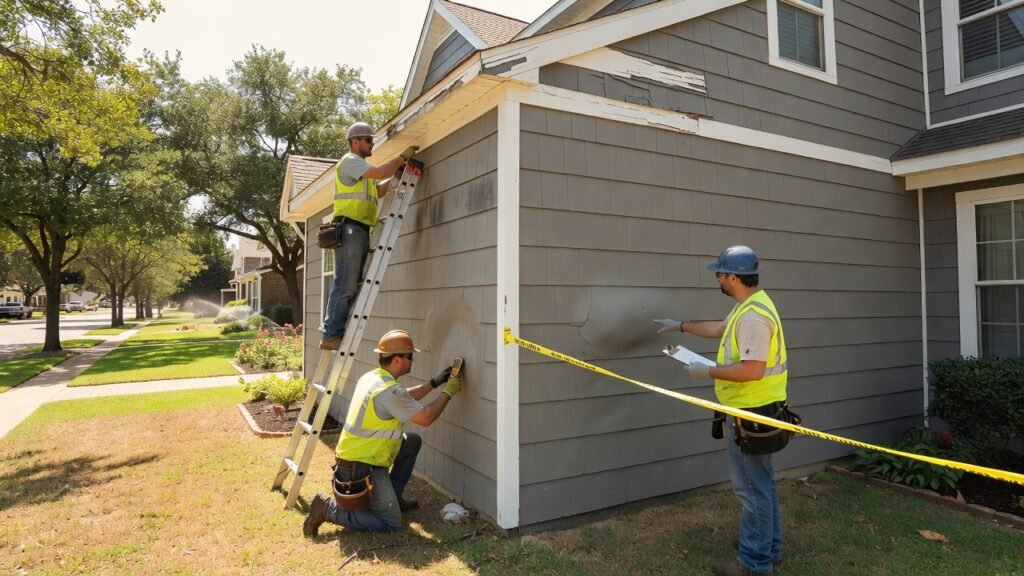
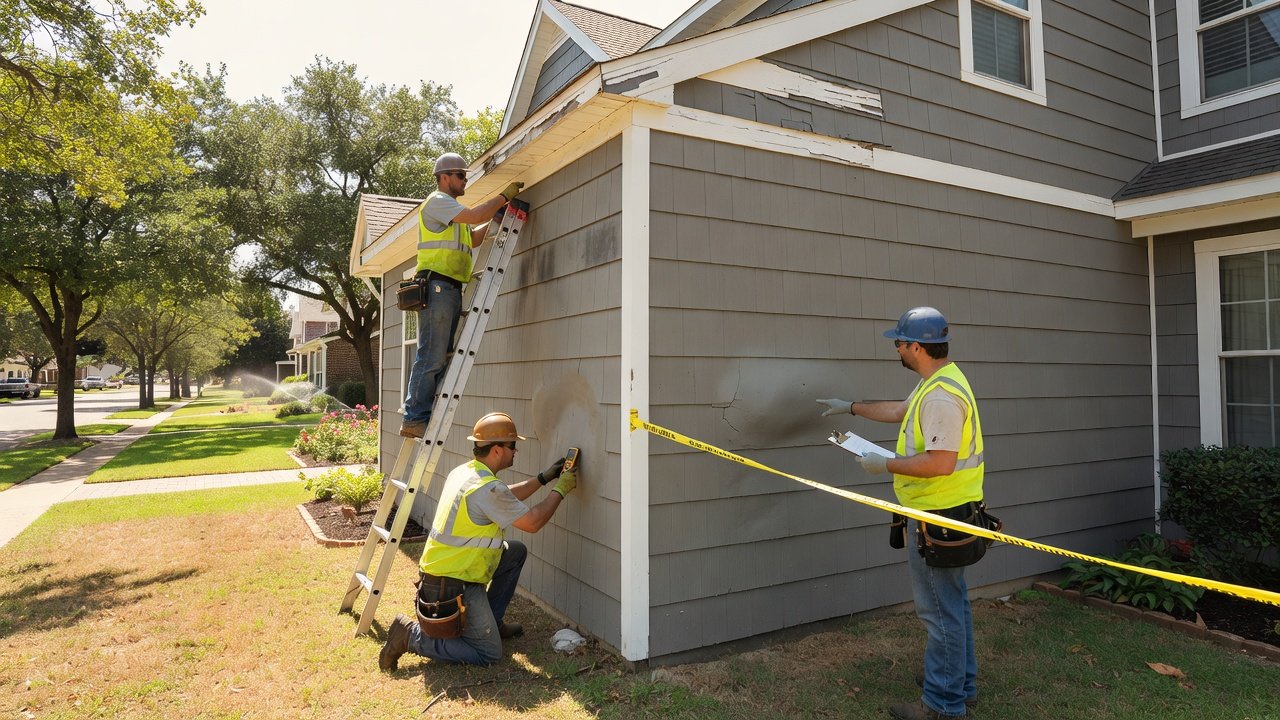
The diagnostic step most homeowners skip is probing behind the damage. A siding panel can look like it needs a coat of paint when the OSB sheathing beneath it has been wet-cycling for two full seasons. We use moisture meters before we quote anything. If readings are above 19%, we’re looking at potential mold and compromised structural sheathing, not a painting project.
The professional fix involves removing the affected run of siding, replacing sheathing where warranted, installing a proper house wrap layer, and re-siding with a material appropriate to Dallas’s climate profile. As of 2026, James Hardie fiber cement and engineered wood products remain our most-specified choices for this region because they handle the thermal swing without the moisture absorption issues we see with traditional wood.
Can this be prevented? Yes. Caulking penetrations annually and maintaining a six-inch clearance between soil grade and siding bottom edge eliminates the majority of moisture intrusion pathways we diagnose in older homes across Garland and Mesquite.
Roof-to-Wall Flashing That Has Quietly Failed
Symptom: water stains on interior ceilings near exterior walls, or efflorescence streaking on brick near chimney chases. Homeowners almost always blame the roof deck first. The actual cause is usually step flashing or counter-flashing that has lifted, corroded, or was never properly embedded in the mortar joints to begin with.
Failed flashing is a safety issue, not just a water issue. Persistent moisture intrusion at the wall-to-roof junction feeds mold colonies inside wall cavities. By the time a stain appears on your ceiling, you may already have a biology problem inside your framing. We’ve opened walls in Oak Cliff bungalows and Preston Hollow traditional homes and found conditions that required full remediation before renovation could begin.
The fix is methodical: remove and replace compromised flashing sections, re-point any mortar joints involved, apply compatible sealant, and re-integrate with the roofing system above. It is not a caulk-and-go repair. A bead of silicone over bad flashing delays the next inspection call by about eighteen months and doubles the eventual repair cost.
Foundation-Level Brick Veneer Cracking
North Texas expansive clay soils are the underlying cause of more exterior renovation calls than any other single factor. Dallas-area homes in neighborhoods like Lakewood and the M Streets sit on soils that can shift several inches vertically between a wet spring and a dry August. Brick veneer isn’t load-bearing, but it telegraphs foundation movement clearly.
Symptom: stair-step cracking through mortar joints, horizontal cracking at the brick-to-foundation interface, or veneer pulling away from window frames. The diagnostic question our estimators ask first is whether the cracking is active or historical. We do this by examining crack edges. Sharp, clean edges with no dust accumulation suggest recent or ongoing movement. Rounded edges with dirt packed in suggest older, likely stabilized movement.
Active foundation movement requires a geotechnical assessment before any veneer repair begins. Patching brick over an actively moving foundation is money wasted and, frankly, misleading to a future buyer. Where movement has stabilized, tuckpointing the mortar joints and addressing any displaced weep holes restores both function and appearance.
Can this be prevented? Maintain consistent soil moisture around your foundation perimeter year-round. During Dallas dry spells, a slow-drip soaker hose along the foundation line reduces the shrink-swell cycle significantly.
Deteriorated Wood Trim and Fascia
Fascia rot is the quiet threat behind half the gutter failures we see across the Dallas metro. When fascia decays, the gutter pulls away, water overshoots the system, and it pours directly against the foundation rather than being routed away from it. What starts as a $600 fascia replacement becomes a $3,000 gutter realignment and foundation drainage correction.
We replace deteriorated fascia with PVC trim board or primed finger-joint pine depending on the home’s architectural profile, then re-mount gutters with proper pitch and hanger spacing. We also check soffit ventilation in the same pass blocked soffits in attic spaces cause their own moisture and heat problems that feed back into exterior material failures.
Window and Door Frame Seal Failure
In Dallas’s 2026 energy environment, a failed perimeter seal around a window frame is not just a drafty annoyance. It is an ongoing utility cost and a moisture entry point. Symptoms include visible gaps at the frame-to-siding joint, condensation between double-pane glass, or paint failure at window corners that keeps recurring no matter how many times you repaint.
The professional fix addresses the source rather than the surface. We remove the existing exterior casing, inspect the rough opening for moisture damage, install flashing tape at the sill, re-caulk with a paintable urethane product rather than standard acrylic latex, and reinstall or replace the casing. The Harvard Joint Center for Housing Studies found in 2024 that homeowners who invest in professional renovation see 15 to 20 percent higher satisfaction scores compared to DIY projects of equivalent scope and window frame failures are one of the most common callbacks we see from self-managed repairs.
What Deferred Exterior Work Actually Costs in Dallas
“We thought it was just cosmetic. We had no idea the sheathing behind it was essentially compost.” — Homeowner in the M Streets district, whose $900 siding patch estimate became a $14,200 remediation and re-side project after our moisture assessment.
The U.S. Census Bureau’s 2024 Survey of Construction confirmed that spending on residential improvements and repairs in the United States exceeded $500 billion annually. That number reflects, in part, the cost of deferred maintenance catching up with homeowners who waited too long on exterior systems. In a climate as aggressive as Dallas freeze events in winter, sustained heat in summer, severe hail corridors cutting through everything from Mesquite to North Garland exterior materials work harder and fail faster than in more temperate regions.
According to the 2025 Remodeling Cost vs. Value Report by Remodeling Magazine, mid-range exterior renovation projects recoup a meaningful percentage of cost at resale, with fiber cement siding replacement among the stronger performers nationally at this price tier. In a competitive Dallas real estate market, exterior condition is often the first filter buyers apply.
How We Approach an Exterior Renovation Diagnosis in Dallas
Our process starts with a full perimeter walk before we open any pricing conversation. We look at drainage patterns, grade slope, penetration sealing, material transitions, and evidence of prior repairs. Prior repairs tell us a lot a patch that has already failed once tells us the original failure mode was never correctly identified. We also flag anything that touches safety: unsecured panels in high-wind exposure zones, compromised attic ventilation, and any sign of pest intrusion through exterior gaps.
If you’re also planning interior updates, our full renovation packages frequently bundle exterior and interior scopes at a reduced mobilization cost, since the crew is already on-site and staging equipment.
OSHA data confirms that projects managed by licensed general contractors carry significantly lower incident rates than self-managed or unlicensed construction work something worth considering when you’re pricing exterior work in a competitive market where the lowest bid often reflects the thinnest safety protocols.
If your home in Dallas, whether in Oak Cliff, Preston Hollow, Lake Highlands, or anywhere in between, is showing any of the symptoms described here, the right move is a professional assessment before the next storm season. Contact A1 Construction and Renovation Service and let our team walk your exterior with you. We’ll give you a straight answer about what’s urgent, what can wait, and what it will actually cost.
Frequently Asked Questions
How much do exterior renovation services in Dallas typically cost in 2026?
Scope drives cost more than anything else. A focused fascia and soffit replacement on a single-story Dallas home might run $2,500 to $6,000. A full re-side on a two-story home in Lakewood or Preston Hollow, including sheathing replacement where needed, typically lands between $18,000 and $40,000 depending on square footage and material choice. We provide itemized estimates after a physical walkthrough phone estimates on exterior work are rarely accurate because the condition behind the visible surface is what moves the number.
Do I need a permit for exterior renovation work in Dallas, TX?
As of 2026, the City of Dallas requires permits for structural repairs, window replacements that change the rough opening size, and re-roofing projects. Cosmetic repairs like painting or limited caulking do not require permits. Work done in specific historic districts, including parts of Oak Cliff and the M Streets corridor, may also require review by the Landmark Commission. Our project managers handle permit applications and inspections as part of our standard process.
How do I know if my exterior damage is urgent or something I can schedule a few months out?
Active water intrusion, exposed sheathing, displaced flashing, and any structural cracking that appears to be growing are urgent they worsen with every rain event and every temperature swing. Cosmetic issues like faded paint, minor caulk shrinkage, or surface-level efflorescence on brick can typically be scheduled within a season without significant risk. When in doubt, a quick exterior assessment from our team takes about an hour and gives you a clear priority ranking so you’re not guessing.
Related from A1 Construction & Renovation: Structural Renovation City · ADU Construction City · Remodeling City


